
Why Psilocybin Research Focuses on High Doses
Quick Summary
Most scientific studies on psilocybin use high, therapeutic doses to get clear, measurable results for treating serious conditions. This is different from the real world, where microdosing is extremely common for general wellness, because the subtle effects of microdosing are harder to study in a lab setting.

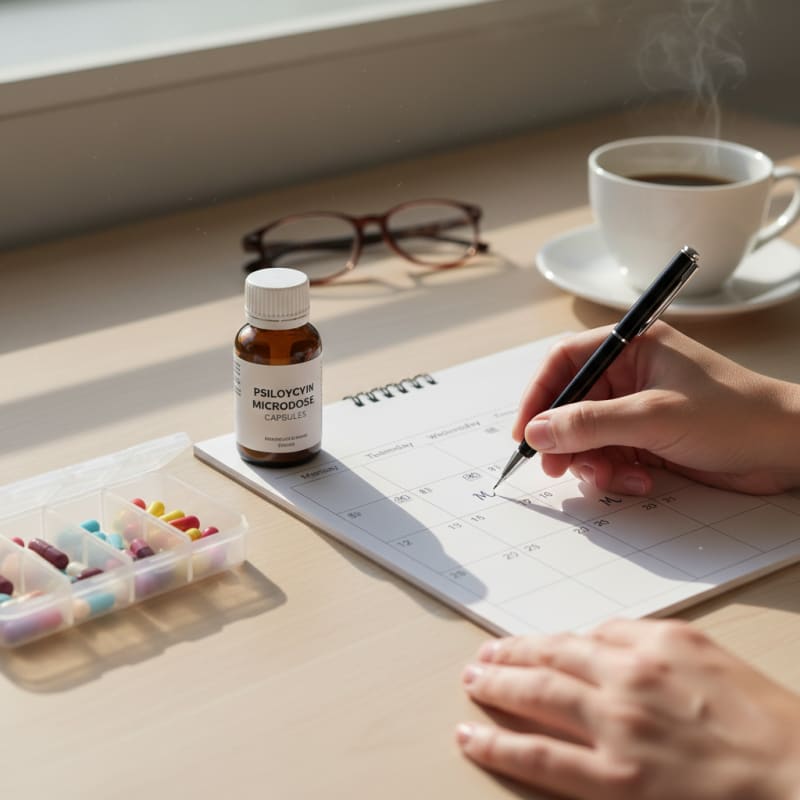

Recent data reveals a fascinating divide in the world of psilocybin. On one side, there is the rapidly growing, high-profile field of clinical research, which is almost exclusively focused on large, therapeutic doses. On the other, there is the widespread, real-world use, where sub-perceptual microdosing is now staggeringly common. A 2026 RAND study highlighted this reality, estimating that of the millions of adults who use psilocybin, nearly half of all usage days are microdosing days. This leads to a critical question: if microdosing is so prevalent, why does the lion's share of scientific funding, media attention, and academic discussion centre on high-dose macrodose experiences?
The answer lies in the pragmatic, methodical, and necessarily cautious nature of scientific research. The divergence isn't an oversight but a result of the specific goals and limitations of the clinical trial model.
What Does Clinical Psilocybin Research Involve?
When institutions like Johns Hopkins or independent researchers study psilocybin, they are typically not investigating its use for enhancing creativity or improving day-to-day mood. Their focus is on treating specific, often severe, health conditions. This includes major depressive disorder, post-traumatic stress disorder, end-of-life anxiety in cancer patients, and substance addiction, such as smoking cessation.
These studies follow a rigorous protocol:
- High Doses: Participants are given a single, large dose of psilocybin, typically ranging from 20mg to 30mg, in a controlled, clinical setting.
- Therapeutic Support: The experience is not undergone alone. It is facilitated by trained therapists who prepare the participant beforehand, provide support during the multi-hour session, and help them integrate the experience afterward.
- Specific Outcomes: The goal is to measure a clear, clinically significant outcome. Did the patient's standardized depression score decrease by a certain percentage? Did they successfully abstain from smoking for six months? The effects must be pronounced and statistically verifiable.
This model is designed to produce what researchers often call a "peak" or "mystical-type" experience. This powerful, consciousness-altering state is believed to be a key mechanism of the therapeutic effect, allowing individuals to gain new perspectives on their life, their behaviours, and their illness. It’s an acute, powerful intervention intended to create a lasting psychological shift.
Why the Emphasis on Macrodoses?
The intense focus on macrodoses in a lab setting stems from several practical and methodological reasons. It is not an implicit judgment on the value of microdosing, but rather a reflection of how legitimate scientific inquiry must operate.
The Problem of Placebos A cornerstone of credible medical research is the double-blind, placebo-controlled trial. To prove a substance is effective, its results must be significantly better than those from a placebo (a "sugar pill"). The effects of a high-dose psilocybin experience are profound, intense, and impossible to mistake for a placebo. It is undeniably a powerful psychoactive event. Microdosing, by definition, produces sub-perceptual effects. While users may report subtle shifts in mood, focus, or creativity over time, these effects are much harder to distinguish from a placebo in a controlled study. A participant who feels a little more productive or positive could easily be experiencing the placebo effect, making it incredibly difficult and expensive to design a study that can definitively prove the microdose itself was the cause.
The Need for Measurable Results Clinical research is built on data. A study investigating psilocybin for smoking cessation can produce a very clear metric: the number of participants who quit smoking. Research into major depression can measure changes using validated clinical scales like the HAM-D. These large, dramatic changes are what regulatory bodies and the scientific community require to approve a new treatment. The subtle, qualitative improvements often attributed to microdosing—such as "feeling more present" or "increased flow state"—are immensely harder to quantify and are not considered primary endpoints for treating a disease.
The Medical and Regulatory Model Modern medical research operates on a paradigm of treating specific diseases with targeted interventions. A high-dose psilocybin session fits neatly into this model. It is an acute, powerful treatment administered under medical supervision to address a diagnosed condition. This is a framework that entities like Health Canada and the U.S. FDA understand and are equipped to evaluate. In contrast, microdosing fits more into a wellness or enhancement model—using a substance regularly to optimize an already healthy system. This is a fundamentally different approach that falls outside the traditional "disease treatment" scope of most psychedelic research centres. For everyday wellness, people often turn to more accessible formats like the Clarity Microdose Capsules.
How Does This Compare to Real-World Use?
The data from the RAND study confirms what many in the community have known for years: the clinical world and the real world of psilocybin are very different. While researchers are focused on single, transformative experiences in a lab, millions of people are engaging with psilocybin in a completely different way.
Real-world use, particularly microdosing, is characterized by:
- Low, Sub-Perceptual Doses: Taking a fraction of a therapeutic dose to avoid psychoactive effects.
- Regular Schedules: Dosing protocols like one day on, two days off, are common.
- Wellness Goals: The intent is not to treat a severe illness but to enhance general well-being, improve focus at work, facilitate emotional processing, or reduce minor anxiety. Many find that precisely dosed products, such as convenient psilocybin gummies, are ideal for this purpose.
- Autonomy: This is done privately, without clinical oversight, as part of a personal wellness routine.
While science is rigorously exploring one specific, powerful application of psilocybin, the general public is simultaneously pioneering another. Many users who are new to the practice find that starting with pre-portioned mushroom capsules removes the guesswork and provides a consistent experience, a level of precision unavailable in clinical settings outside of a trial. This growing movement is detailed further in our article on microdosing as a mainstream practice.
The divergence between clinical research and widespread public practice highlights the two distinct paths psilocybin is currently carving in modern society: one as a targeted, high-dose therapeutic agent, and the other as a sub-perceptual tool for personal wellness.

ShroomDash Editorial Team
Published 2026-03-27 · 4 min read read · Dosing