
Psilocybin, Lion's Mane & Niacin Stacks
Quick Summary
Many microdosers "stack" psilocybin with Lion's Mane mushroom and Niacin B3, believing it enhances the effects. However, a large scientific study found that this combination did not improve mood or mental health beyond what psilocybin achieved on its own. The primary benefits appear to come from the psilocybin itself.
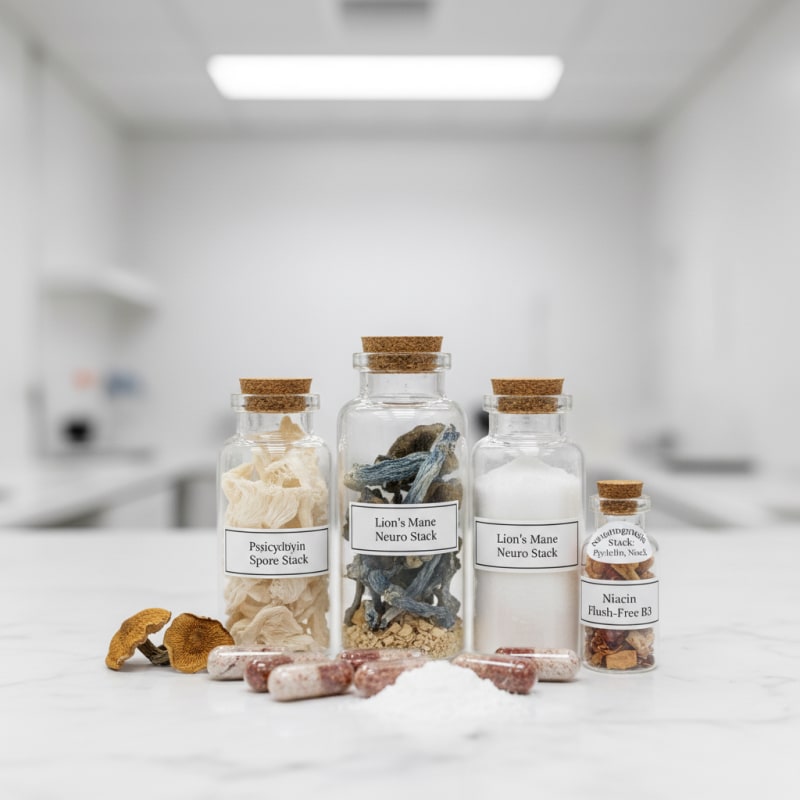
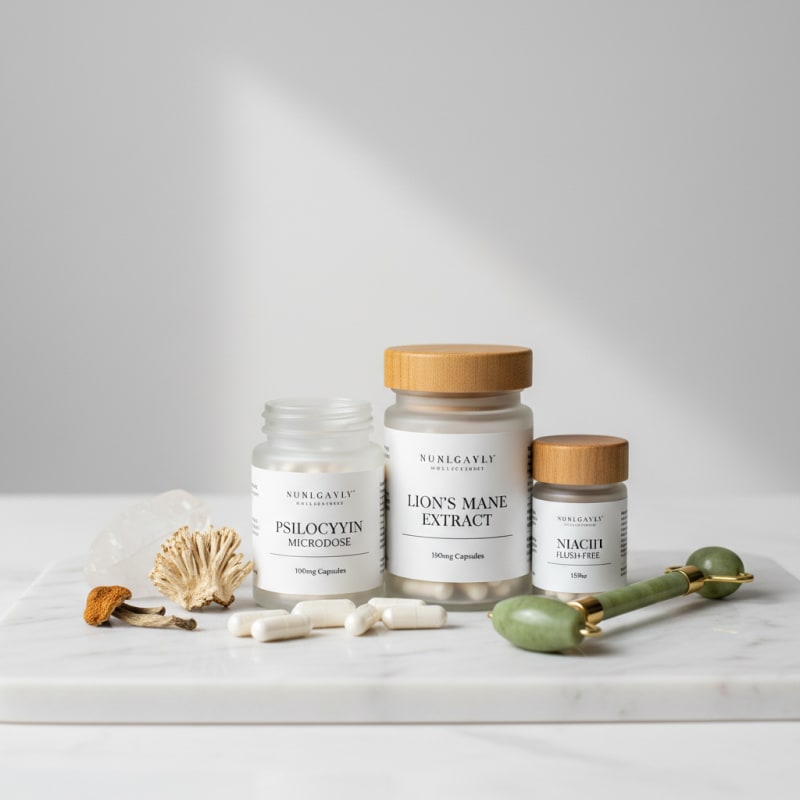
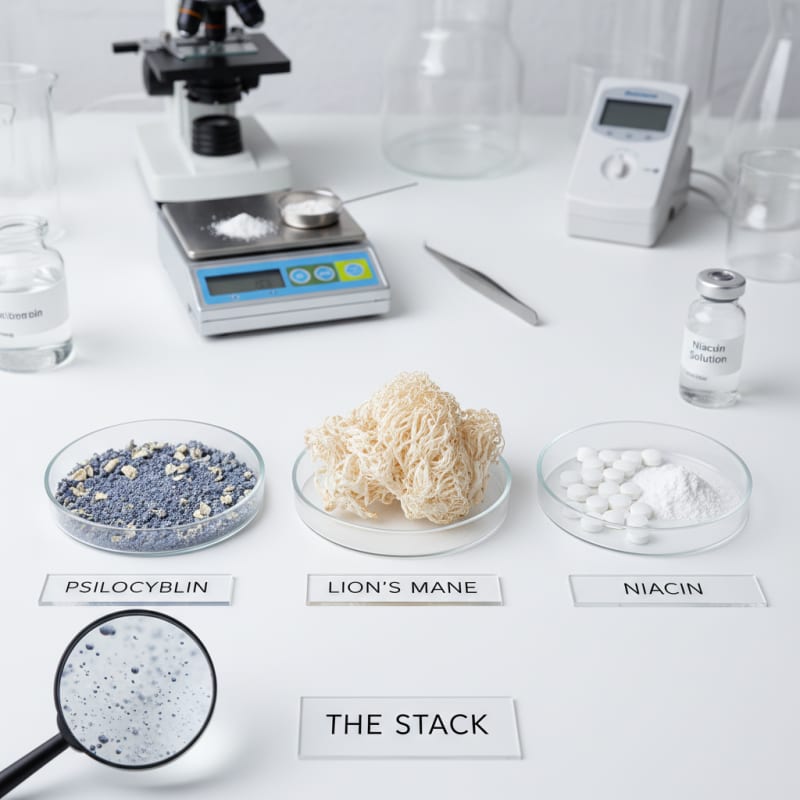

The practice of microdosing involves taking sub-perceptual doses of psilocybin to enhance mood, creativity, and focus without producing a psychedelic experience. As interest in microdosing has grown, so has the practice of "stacking"—the combination of psilocybin with other non-psychoactive ingredients to theoretically enhance or direct its effects. The most well-known of these combinations is a stack containing psilocybin, Lion's Mane mushroom (Hericium erinaceus), and Niacin (Vitamin B3), popularized by mycologist Paul Stamets.
This specific combination, often referred to as the "Stamets Stack," is built on a theory of synergistic action. Proponents suggest that each component plays a distinct role in promoting neurological health. Psilocybin is thought to stimulate neurogenesis, Lion's Mane is a functional mushroom believed to support nerve growth, and Niacin is included to facilitate the distribution of the other molecules. While the theory is compelling and has gained significant traction in online communities, it is essential to examine the scientific evidence supporting its purported benefits. As researchers begin to study these practices more formally, a clearer picture is emerging about how these stacks function and whether they live up to the claims.
What Is the Theory Behind the Stamets Stack?
The "Stamets Stack" protocol is based on a hypothesis about brain health and cognitive function. The theory proposes that these three components work together to create a synergistic effect that is greater than the sum of their parts. Understanding this theory requires looking at the proposed role of each ingredient.
- Psilocybin: At the core of the stack, sub-perceptual doses of psilocybin are believed to interact with the brain's serotonin 5-HT2A receptors. This interaction is thought to increase neuroplasticity—the brain's ability to form and reorganize synaptic connections. This process is central to learning, memory, and recovering from brain injury or mood disorders. The foundational idea of microdosing is that these neuroplastic changes can occur even without a full psychedelic experience. For a deeper dive into consistent dosing, our post on why dosing consistency matters more than strain names offers valuable insights.
- Lion's Mane (Hericium erinaceus): This edible and medicinal mushroom is not psychoactive but has been studied for its own neurological benefits. Lion's Mane contains compounds called hericenones and erinacines, which research suggests can stimulate the synthesis of Nerve Growth Factor (NGF). NGF is a protein that is crucial for the survival, maintenance, and regeneration of neurons. The theory is that by adding Lion's Mane, the stack further supports the growth and health of brain cells, complementing the neuroplasticity promoted by psilocybin.
- Niacin (Vitamin B3): Niacin is the most debated component of the stack. The rationale for its inclusion is its ability to induce vasodilation, particularly a "flush" effect where capillaries expand and bring more blood to the skin's surface. The hypothesis is that this vasodilation acts as a delivery mechanism, helping to carry the psilocybin and Lion's Mane molecules across the blood-brain barrier and into more distal parts of the peripheral nervous system. This is intended to ensure wider distribution and absorption of the primary active compounds.
Together, the stack is intended to repair and create neurons, enhance cognitive function, and improve mood. While many individuals self-report positive outcomes, these anecdotal accounts require validation through controlled scientific research.
What Does Research Say About Stacking?
As the popularity of microdosing and stacking has surged, the scientific community has begun to investigate the claims. One of the largest and most significant studies to date offers critical insights. An observational study published in the journal Nature in 2022 followed nearly 1,000 psilocybin microdosers and a control group of non-microdosers over a 30-day period. The study observed small to medium improvements in mood and mental health among those who microdosed compared to those who did not.
However, a key part of this study involved a supplementary analysis looking specifically at the practice of stacking. The researchers compared the outcomes of individuals who took psilocybin alone to those who combined it with Lion's Mane and Niacin. The results were telling: the stack did not appear to confer any additional improvements to mood or mental health beyond those seen with psilocybin on its own. This finding suggests that the primary driver of the mental health benefits reported by microdosers is likely the psilocybin itself, not the supplementary ingredients.
The study did find one notable exception. Among older adults (over 55), those who used the stack showed significant improvements in psychomotor performance compared to those who microdosed with psilocybin alone. These tasks involved finger tapping, a measure of motor speed and coordination. This suggests that while the stack may not enhance mood benefits, it could have specific applications for motor function in aging populations. This aligns with the neurogenerative theories behind both psilocybin and Lion's Mane but indicates the effects may be more specific than broadly cognitive or mood-enhancing. Anyone new to the practice should start by learning the fundamentals, and our practical guide to low-dose psilocybin use is an excellent resource.
Does Niacin Actually Enhance Potency?
The role of Niacin as a "flushing agent" is a core tenet of the stacking theory, but it is also the component with the least direct scientific support. The characteristic niacin flush is a real physiological reaction to higher doses of the vitamin (typically over 100mg), causing temporary redness, warmth, and itching of the skin. This is due to the activation of receptors in skin capillaries, leading to vasodilation.
The critical question is whether this peripheral vasodilation translates to enhanced delivery of other molecules to the brain. There is currently no strong clinical evidence to support this hypothesis. The blood-brain barrier is a highly selective membrane that regulates the passage of substances into the brain, and the cutaneous vasodilation caused by niacin does not necessarily affect its permeability. The mechanisms that govern transport into the central nervous system are far more complex than simple blood flow. While Niacin is an essential vitamin for overall health and cellular metabolism, its specific role in amplifying the neurological effects of psilocybin and Lion's Mane remains theoretical and unproven in a clinical context.
Many users who try the stack report the flushing sensation to be uncomfortable and distracting, without any perceptible enhancement of the microdose's effects. Given the lack of evidence and the potential for discomfort, its inclusion in the stack is a matter of personal belief rather than scientific certainty. For those focused on a straightforward approach, our precisely dosed Microdose Capsules provide a reliable foundation for any microdosing regimen.
Ultimately, the practice of stacking originated from theoretical models of neurochemistry. The available scientific data has yet to validate the synergistic mood-enhancing claims, instead pointing toward psilocybin as the primary active ingredient responsible for the observed benefits. While our Mushroom Gummies offer an alternative format, the principle remains the same: the key to a consistent experience is the precision of the active ingredient.
The ongoing exploration into microdosing and stacking highlights a gap between anecdotal reports and formal research. While the combination of psilocybin, Lion's Mane, and Niacin may offer specific psychomotor benefits for certain demographics, the generalized claims about enhanced mood and cognition are not yet supported by evidence. Current research indicates that psilocybin alone accounts for the significant positive changes in mental health observed in microdosers.

ShroomDash Editorial Team
Published 2026-02-24 · 5 min read read · Microdosing